VCOM Cloud
Breadcrumbs

Portal structure

Last modified:


Top bar

The top bar of the portal
The portal’s top bar

Name

Details

1

apps_40dp_000000_FILL0_wght400_GRAD0_opsz40.png Application launcher


Access mc Cloud and all your other meteocontrol applications.

2

icon-question5.png Help

The help menu includes:

  • new_releases.png What’s new: Link to the portal’s release notes.

  • icon-question5.png Link to this mc Help Center.

  • headset_mic.png A Support request form.

  • keyboard.png Information on the portal’s Shortcut keys.

  • privacy_tip.png Link to the portal’s Privacy policy.

  • message.png System Messages.

  • extension.png Link to information on Third-party licenses.

  • code.png Link to the portal’s Developer space and API documentation.


The image-20260116-074846.png yellow dot indicates a new release.

3

image-20260116-080550.png Your avatar


In the avatar’s menu you can:

  • Access and edit your settings.png Profile settings, such as email address or password.

  • Choose the portal's language.png Language. You can choose from 9 languages.

  • color_lens.png Brightness mode: View the portal in either light or dark mode.

  • refresh.png Automatic refresh: Activate the toggle and new data is checked every 5 minutes. Deactivate the toggle to turn off automatic updates.

  • settings_backup_restore.png Cycling: Activate the toggle to switch the view from one system to the next at an interval of your choosing.

  • logout.png Sign out from the portal.

Operating levels

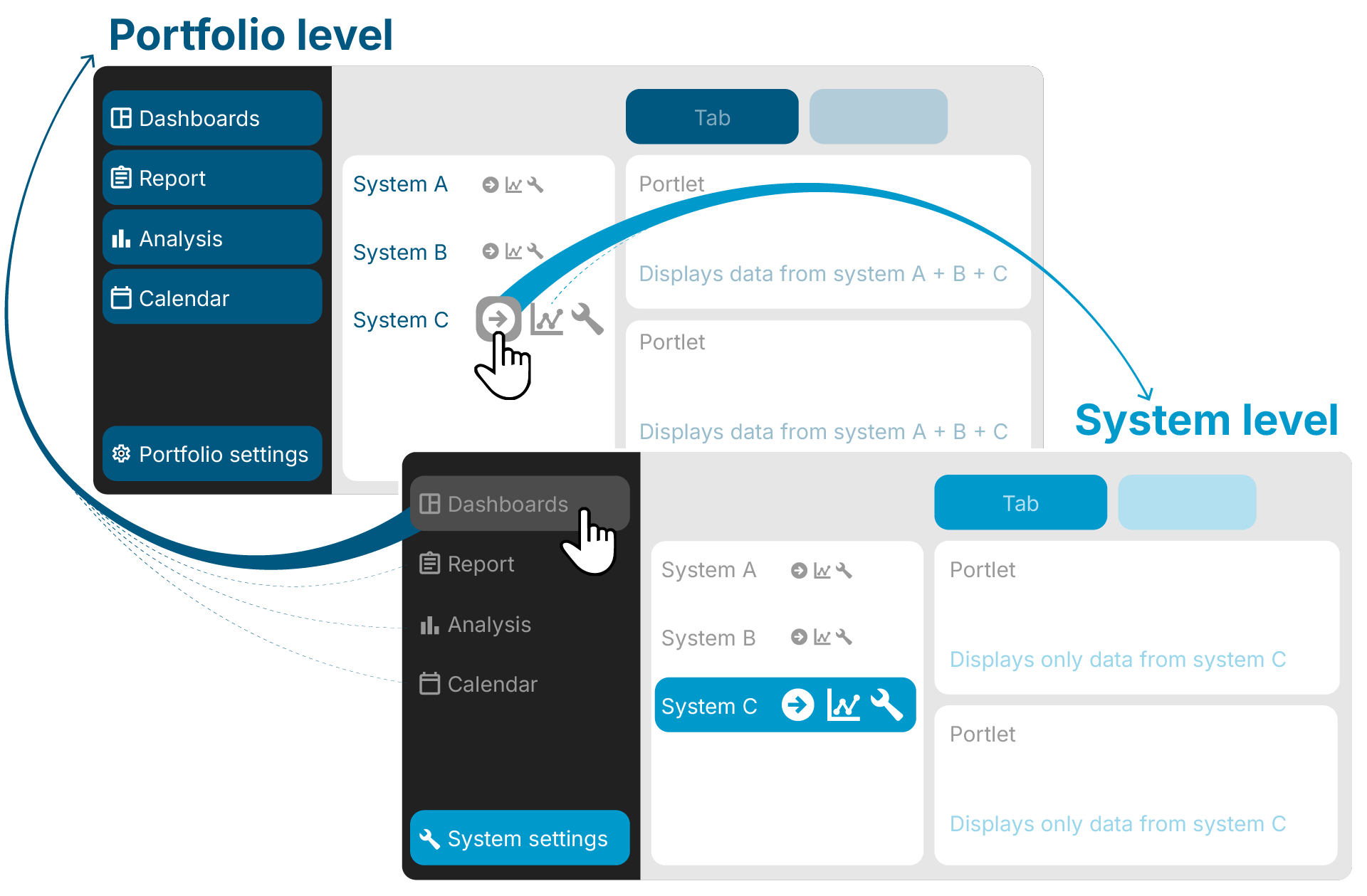
There are two operating levels in VCOM, the portfolio and the system level
There are two operating levels in VCOM: The portfolio and the system level

In VCOM, there are two main operating levels. Choosing one will change the view of the content area:

portfolio level : This operating level gives you an overview of all your systems in VCOM.

Adjust administrative settings that affect your entire portfolio, such as user management, at this level under icon-cog1(1).png Portfolio administration.
When accessing VCOM, you usually access at portfolio level. When you later want to return from system to portfolio level, select icon-home21(1).png Control room. Alternatively, you could also directly navigate to special portfolio level actions, such as icon-stats-bars21(1).png Analysis, icon-calendar1(1).png Calendar or icon-file-text21(1).png Reports.

system level : This operating level is the individual view of each system (= plant).

Adjust settings that affect an individual system, alarms, term-definition, and feed-in revenue at this level under icon-wrench1.png System configuration.

To access a system level, hover over a system name in the systems list and select icon-circle-right4.png Go to cockpit. Alternatively, you could also directly navigate to the Evaluation tab by selecting icon-stats-dots1.png Go to evaluation.

Note

Both operating levels display information with the help of portlets that are organized in tabs, see Portlets and tabs.

Portfolio level

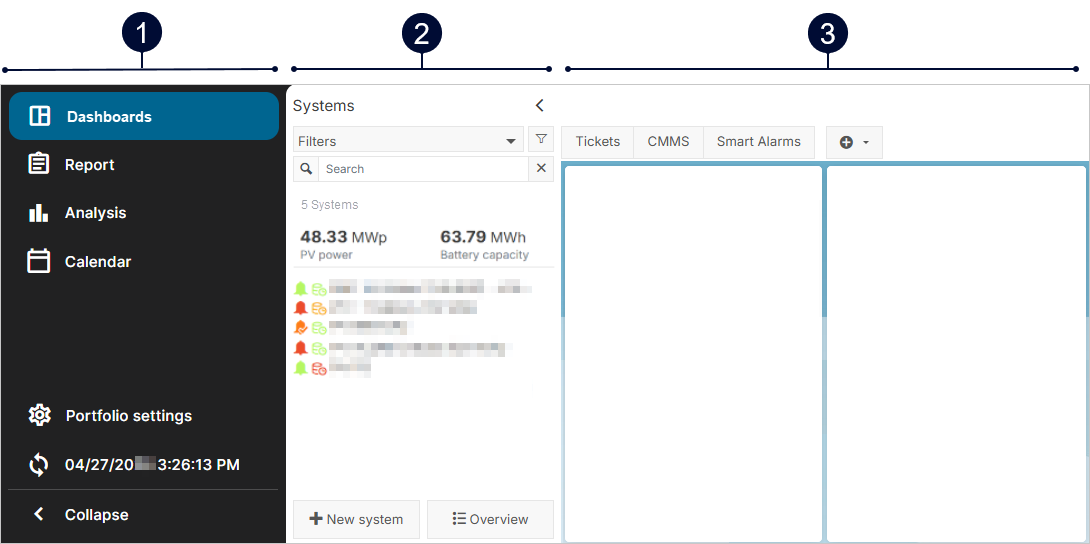
Control room at portfolio level

Name

Details

1

icon-home21(1).png Control room

Overview of your portfolio.

2

Portfolio level actions

  • icon-stats-bars21(1).png Analysis: Create your own charts for all systems. Analyses can be placed on your dashboards using the Analysis portlet. You can also use the charts in your reports.

  • icon-calendar1(1).png Calendar: Keep track of one-time or regular appointments for your systems.

  • icon-file-text21(1).png Reports: Generate portfolio, CSV, and CMMS reports. See also Reporting.

3

icon-cog1(1).png Administration for your entire portfolio

Adjust settings that affect your entire portfolio, such as user management or system setups.

4

Portfolio level tabs

Portlets are organized in different tabs.

5

icon-plus-circle2.png Options for the portfolio’s portlet center and tab management

Add and manage portlets and tabs. See also Portlets and tabs.

6

Filters & Search

Search or filter your systems list based on different criteria. See Filters for the systems list.

7

Systems list

List of systems in your portfolio.

  • Select a different system name to change the displayed data in dynamic portlets, such as the Map portlet or the Tickets portlet.

Expanded icon view:

  • icon-database-time2.png System and device communication: Color indicates whether system and device communication is ok/not ok. See Communication loss alarms and Data outage alarms.

  • icon-bell2(1).png Alarms: Color indicates whether any alarms are active/critical. Relevant for all alarms except Communication loss and Data outage. See Smart alarms.

  • Vector.png All alarms processed: The checkmark indicates that all open alarms are already assigned to a ticket.

System level

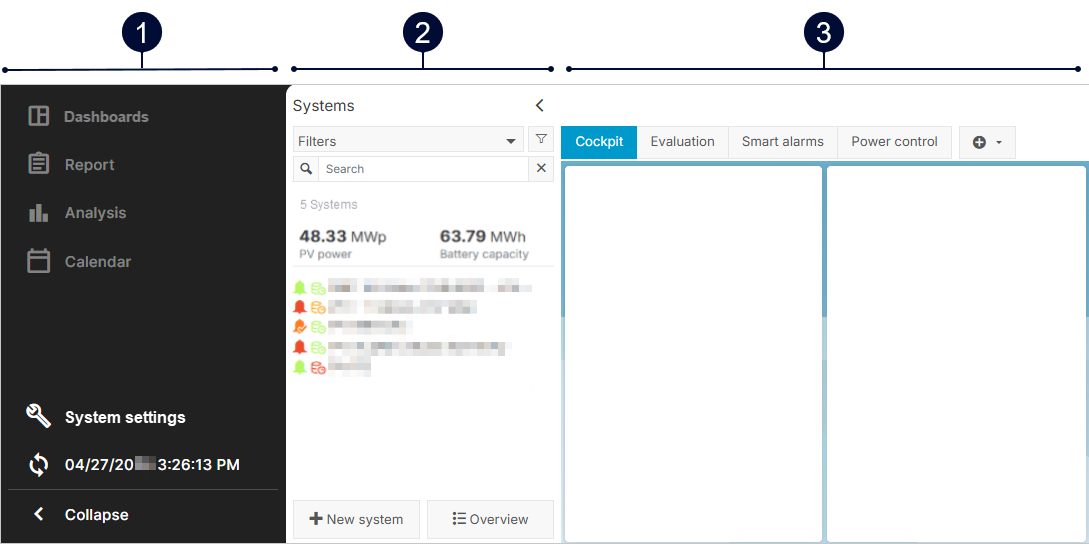
Cockpit tab at system level

Name

Details

1

System name

User-defined name of the system.

2

icon-wrench1.png System configuration

System configurations that affect the individual system.

Find a shortcut to this action also next to every system name in the systems list.

3

system level tabs

Portlets are organized in different tabs.

4

icon-plus-circle2.png Options for the system’s portlet center

Add and manage portlets. See also Portlets and tabs.

5

Systems list

Navigate to other system levels in your portfolio.

6

icon-home21(1).png Control room and portfolio level actions

Return to the portfolio level.