.svg)
Last modified:
About the ramp rate limiter
To avoid rapid changes in the active power and reactive power output, the Ramp rate limiter feature allows the power generating system to follow a defined gradient to increase or decrease the active power output after receiving a new setpoint from the grid operator/third party.
The ramp rate limiter feature is available for active and reactive power control and is applied to the grid operator/third-party setpoint. The functions are described below.
Active power
|
Ramp up |
The ramp rate configured for ramp up only applies to the new setpoint from the grid operator/third party if this increases the active power output. |
|---|---|
|
Ramp up/Ramp down |
You can define separate ramp rates for increasing and reducing the active power output:
|
|
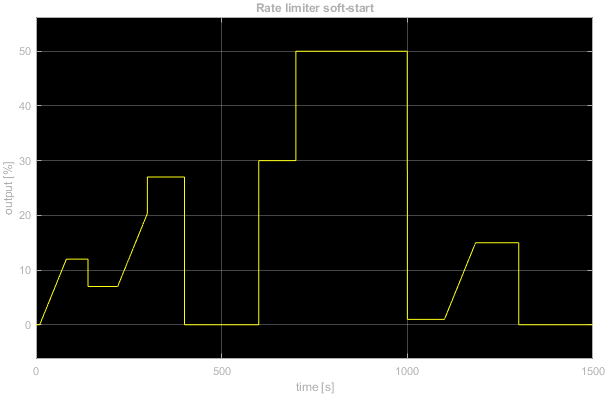
Soft start |
A soft start ramp rate will be applied when the active power at the point of common coupling is ≤ 0 W. The ramp rate remains in effect until the new setpoint is reached. Example: If the active power is 0 W and the setpoint is 0 %, then:
|
|
Activation |
Via the toggle on the user interface or via a Modbus command |
|
Configuration of ramp rates |
Via the toggle on the user interface or via a Modbus command |
Reactive power
|
Ramp |
Applies to the new setpoint from the grid operator |
|---|---|
|
Activation |
Only via the toggle on the user interface |
|
Configuration of ramp rates |
Only via the user interface |
Examples
|
|
Setpoint grid operator input signal |
Output signal |
|---|---|---|
|
Ramp rate limiter off |
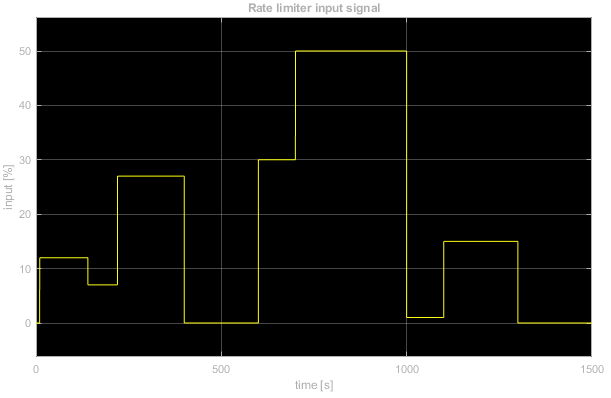
|
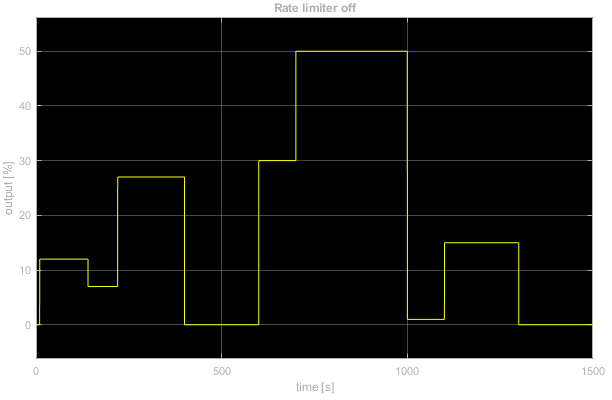
|
|
Ramp up |
.png?cb=3e5df9127d3a934b164360a387b4238f)
|
.png?cb=948125f546b770060c24c01fa58164ac)
|
|
Ramp up/ramp down |
.png?cb=3e5df9127d3a934b164360a387b4238f)
|
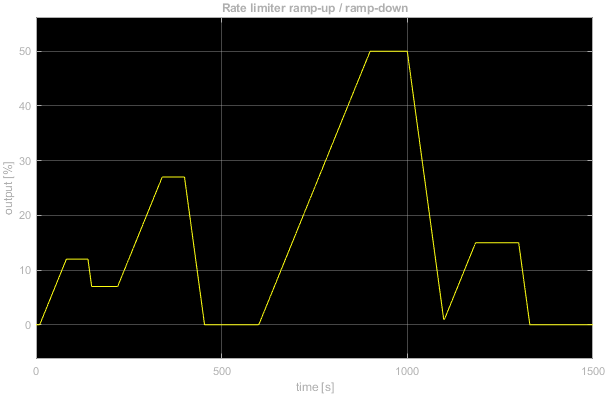
|
|
Soft start |
.png?cb=3e5df9127d3a934b164360a387b4238f)
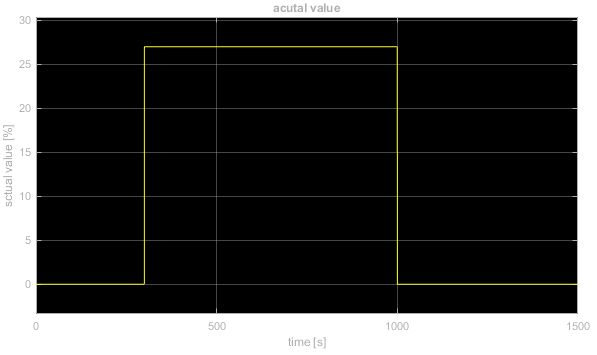
|
|